The Cable Machine That Works in a Commercial Gym and a Home Gym Doesn't Exist
There's no such thing as a cable machine that's right for both a busy commercial gym and a home gym. I know that's inconvenient if you're trying to simplify a product line, and I know it sounds like a supplier talking themselves out of an order. But it's the one thing I'd want a buyer to hear from me before they sign anything.
I handle quality and brand compliance at Cable Machines Sourcing. Every spec sheet, first-article sample, and bulk order that goes out gets signed off by me first — roughly 300 units a year across our commercial cable machine line and our home gym line. In 2024 I rejected about 14% of first-article samples, and most of those rejections were for things the buyer wouldn't have caught until month eight.
That 14% is where this opinion comes from.
"Commercial grade" is a marketing word, not a standard
You can print "commercial grade" on a box tomorrow. Nobody will stop you. There's no license, no test, no inspector. So when a supplier tells you their cable machine commercial models are "built to commercial standards," that sentence carries about as much weight as "premium quality" on a bag of coffee.
What actually exists is a standard, and it's worth knowing the number. EN ISO 20957-1 covers general safety requirements for stationary training equipment, and EN ISO 20957-2 covers strength training equipment specifically. The standard sorts equipment by use — class S for studio and commercial use, class H for home use, class I for institutional settings. A machine built and tested to class S is a different animal from one built to class H, and it's not a subtle difference.
Here's the part that bugs me. I don't have hard data on how many suppliers in this space actually test to class S, because that data isn't published anywhere I've found. But from the test reports I've been handed over four years, my sense is it's well under half. Take that with a grain of salt — it's my sample, not a market survey.
If a supplier can't tell you which class their unit is tested to, or names a standard they can't produce a report for, that's a red flag. Not automatically a deal-breaker, but you should know you're buying on faith at that point.
The frame is not what fails first
This is the piece buyers get wrong most often, and it's genuinely counterintuitive. Everyone stares at the frame. Is it 11-gauge or 14-gauge steel? Is the tubing 2x3 or 3x3? Will the stack hold 300 pounds?
Frames are overbuilt. Almost all of them. Manufacturers know buyers look at the frame, so that's where the visual reassurance goes. I've seen plenty of cheap units with a beefy, nicely welded frame bolted to components that had no business being on a commercial floor.
What actually fails, roughly in the order I see it:
- The cable. Construction, coating, and how it's terminated at the ends. A cable that's fine at three sessions a week degrades badly at sixty.
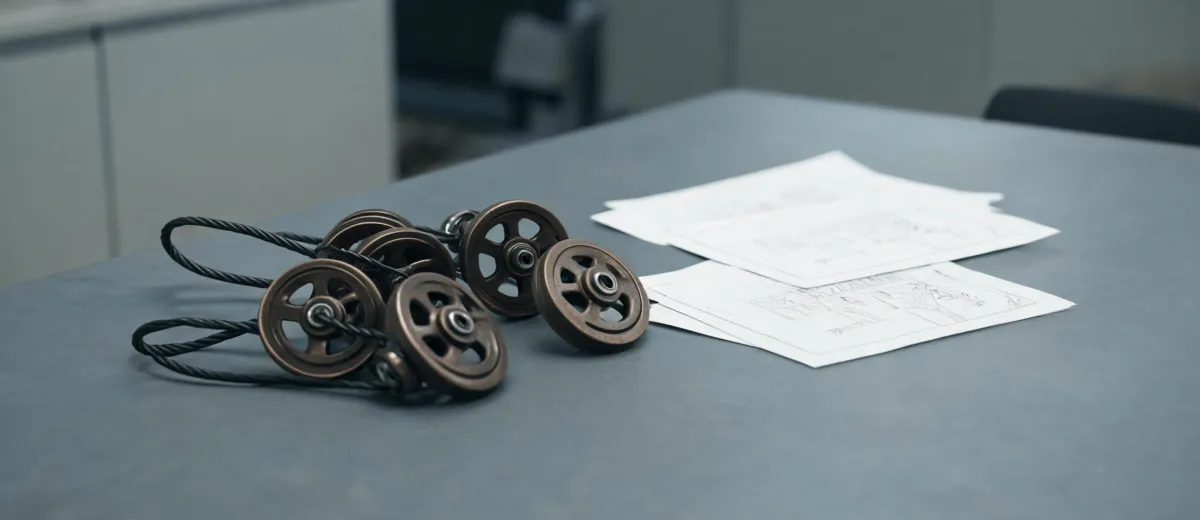
- The pulley bearings. This is the big one. Shielded bearings let chalk, sweat, and dust in. Sealed ones don't. On a cable machine home gym setup, shielded is honestly fine. In a cable machine commercial gym running sixteen hours a day, shielded bearings are a maintenance bill with a delay timer on it.
- The adjustment pin and trolley. Moving parts get abused. On home units they move a few times a week. On commercial floors they move a hundred times a day, by people who don't care how the mechanism works.
- The guide rods. Usually fine, unless someone drops the stack. Someone always drops the stack.
We had forty units go into a 24-hour gym in 2023. The spec sheet looked right and the frames were genuinely solid. The pulley bearings were shielded. Chalk dust and sweat got in within a few months. Nine months in, we were replacing bearings on roughly a third of the units, at our cost, because the contract didn't say sealed and the buyer didn't know to ask.
The frames were fine. The frames were always going to be fine.
A supplier who doesn't ask about duty cycle isn't sourcing
This is where I'll sound self-interested, and I'll own that. But the clearest tell I've found is what happens before the quote.
A real sourcing conversation about cable machines includes questions like: how many hours a day is this in use? How many members or users at peak? Who maintains it, and how fast can they get parts? Is it carded access or open floor? Do you need functional-trainer width or a single-stack unit?
If those questions don't come up, you're not being sourced. You're being quoted.
I'd add one more filter, which is catalog breadth. Some businesses list themselves broadly — a shop that's an electronics cable machine supplier one month and a fitness equipment supplier the next, with cable machines somewhere in a very long menu. Breadth isn't automatically bad. But depth is what protects you. A supplier carrying forty categories has forty category problems, and yours is one of them.
"That's easy for you to say — class S costs more"
Fair. It does.
From the quotes that cross my desk, the spread between a class H unit and a true class S unit is somewhere in the 40–70% range per machine, depending on frame, stack, and pulley spec. Don't hold me to that number — it's my sample, not a published index, and it moves with steel prices and freight.
But here's the honest limitation, because I'd rather lose a sale than ship something that fails in year two. Plenty of buyers don't need class S, and I'll say so to their face.
If you're outfitting a home gym and you're in there three or four times a week for an hour, a home gym cable machine built to class H is the right answer. Full stop. Putting a commercial cable machine system in a garage is usually just spending money to solve a problem you don't have — and you'll still be the one oiling it.
If you're a small studio running under twenty hours a week with a handful of members, you're in the gray zone. Light-commercial units live there. They're a compromise, and I'd rather call them a compromise than pretend they're both things. The deciding question is maintenance: if you've got someone who can swap a cable and a bearing in twenty minutes, light-commercial works. If nobody's on that, buy class S and skip the phone call.
What I won't do is tell a 1,200-member gym that a home-grade unit is "basically the same thing." It isn't, and the invoice will say so in about nine months.
What I'd do differently
Looking back, I wish we'd written duty-cycle class into every quote template back in 2021 instead of 2023. At the time it felt like adding friction to a sales process that didn't need it — buyers wanted a number, not a questionnaire. But given what I already knew about how "commercial grade" gets used as a mood rather than a specification, the friction was the point. We'd have avoided the bearing situation, and probably a couple of others I've mostly forgotten and definitely haven't forgiven.
I can only really speak to what we quote and ship. If you're buying a single unit off a marketplace listing, your leverage looks nothing like a gym outfitting thirty stations, and some of this won't apply. But the core question doesn't change.
Match the machine to the duty cycle, not to the label. If your supplier's answer to "which class is this tested to" is a blank look, that's your answer too.
The supplier who tells you "this one probably isn't right for you" is doing you a favor. They're also the only kind worth keeping on your shortlist.